What Is a Robotic Arm and How Does It Work?
A Robotic Arm is an automated mechanical system that moves tools, parts, or materials with controlled precision. It commonly uses joints, electric motors, gearboxes, sensors, and a programmable controller. Think of a human shoulder, elbow, and wrist, rebuilt from steel and software.
The International Federation of Robotics reported 541,302 industrial robots installed worldwide in 2023. Its World Robotics 2024 report also recorded more than 4.28 million robots operating globally. These figures show strong industrial demand, but they do not explain every workplace reality. A factory may gain speed while facing higher integration costs, maintenance demands, and worker-training needs. Numbers alone can mislead.
How does a Robotic Arm work? A controller receives programmed coordinates or sensor feedback. It then sends precise signals to each motor. Encoders measure joint positions, while end-effectors perform tasks such as welding, gripping, painting, or assembly. In a modern production cell, the arm may lift a metal component, rotate it 90 degrees, and place it within millimetre-level tolerances. Small errors still matter.
Reports from the Association for Advancing Automation and IFR show that successful deployment depends on more than purchasing hardware. Application design, safety assessment, programming, and human oversight remain essential. The machine is powerful, not independent. Understanding its mechanical structure and control logic helps engineers choose suitable payloads, reach distances, speeds, and safety systems. This guide examines those principles clearly, while acknowledging an important limitation: real performance varies with tooling, materials, software, and operating conditions.
Definition and Core Components of a Robotic Arm
A robotic arm is a programmable mechanical system that moves tools through controlled positions. Unlike a fixed machine, it can repeat a path, change speed, and handle different workpieces. Its structure resembles a human arm, but the comparison is limited. The arm does not “understand” a task by itself. It follows instructions translated into motion by a controller. In practical use, its value depends on accuracy, reach, payload, and safe coordination with nearby people. A fast arm is not automatically a useful arm.
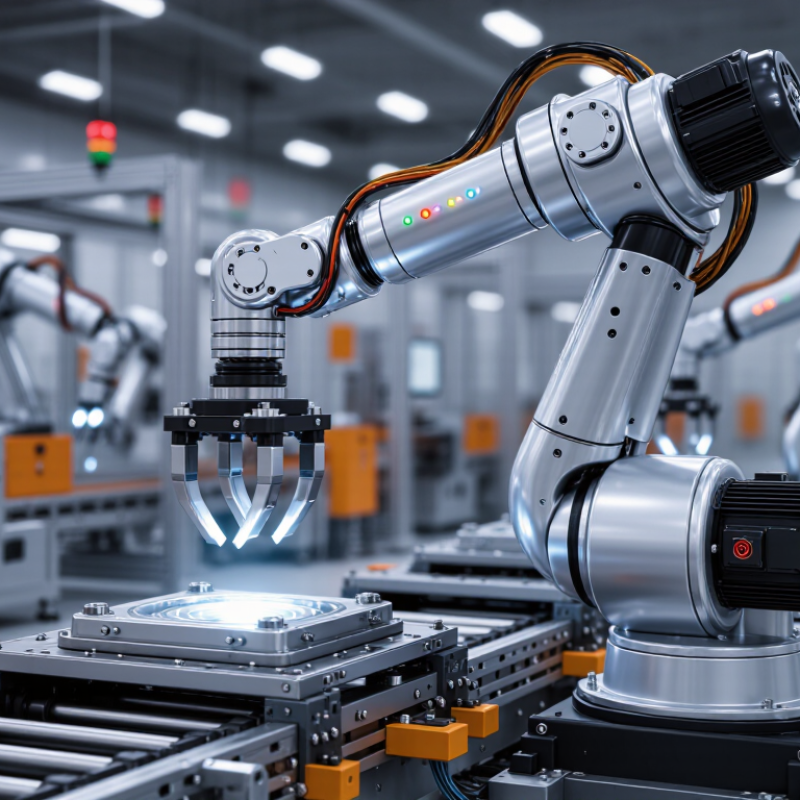
The base anchors the arm and transfers forces to the floor or frame. Links form the rigid sections, while joints provide rotation or linear movement. Each joint contains an actuator, such as an electric drive, plus a transmission that controls force and speed. At the tip, an end effector performs the work. It may grip, weld, screw, inspect, or move an object. Sensors report joint position, motor load, and sometimes contact force. These signals help the controller compare actual movement with the programmed path. Even a small calibration error can shift the tool several millimeters.
The controller acts as the arm’s decision center, coordinating motion, timing, and limits. Software defines poses, trajectories, acceleration, and permitted work zones. Safety devices add another layer through guarded areas, emergency stops, and speed monitoring. In a real cell, setup quality matters as much as hardware. A loose fixture, worn gripper, or poor cable route can cause inconsistent results. The definition sounds tidy, yet operation is not. Engineers must test, measure, and revise the system before trusting repeated motion.
How Robotic Arms Receive Instructions and Plan Movements
What Is a Robotic Arm and How Does It Work?
A robotic arm receives instructions through a controller, software interface, or production system. The instruction may say, “pick the metal housing at position A.” The controller converts that command into coordinates, grip force, speed, and timing. It then calculates joint angles through inverse kinematics. Each motor follows a planned path, not merely a single destination. In a factory cell, an operator may watch the arm approach a tray, close its gripper, and pause when a sensor detects resistance.
Movement planning also uses feedback. Encoders report joint positions, while cameras, force sensors, and proximity devices check the working area. If a part shifts by three millimeters, the controller can adjust the path. Collision models help avoid fixtures and nearby equipment. However, planning is not flawless. A reflective surface, loose cable, or unexpected vibration can confuse sensing systems. Real-world testing still matters.
The International Federation of Robotics recorded 541,302 industrial robot installations worldwide in 2023, with more than 4.28 million robots operating globally in its World Robotics 2024 report. Those figures show why reliable instruction handling is essential at scale. Safety requirements in ISO 10218 and collaborative-operation guidance in ISO/TS 15066 encourage risk assessment, speed limits, and protective monitoring. A practical setup should log every command, sensor response, and stopped motion. Small details matter. A poorly chosen acceleration value can damage a part, reduce accuracy, or make workers lose trust in the system.
The Step-by-Step Process Behind Robotic Arm Motion
What Is a Robotic Arm and How Does It Work?
The Step-by-Step Process Behind Robotic Arm Motion
A robotic arm is a programmable machine with linked joints, motors, sensors, and a tool. Its motion starts with a target, such as moving a component from one tray to another. A controller converts that target into joint angles and movement speeds. It then checks whether the planned path avoids nearby equipment. Small errors matter.
The controller sends electrical signals to each motor. Motors rotate gears inside the joints, while position sensors measure every change. This feedback creates a continuous correction loop. If one joint moves too far, the controller reduces power or reverses direction. The arm follows the planned sequence in small, controlled steps. From hands-on setup, technicians often watch the first cycle at low speed.
At the wrist, an end effector grips, welds, screws, or places an object. Its pressure must match the material. Too little force may drop the part. Too much force may damage it. Safety sensors can pause movement when a person enters the monitored area. Calibration also affects accuracy, especially after tool changes or long operating periods. The process is precise, but not flawless. Temperature, vibration, and worn components can introduce small deviations. Engineers review these results and adjust the program when the arm misses its intended position by only a few millimeters.
Common Types and Applications of Robotic Arms
What Is a Robotic Arm and How Does It Work?
A robotic arm is a programmable machine that moves tools or objects through controlled joints. Motors drive each joint, while sensors track position, speed, and resistance. A controller compares the planned path with real-time feedback. This process helps the arm place a component within a small tolerance. Some systems use six rotating joints. Others move along straight rails.
Common Types and Applications of Robotic Arms
Articulated arms resemble a human shoulder, elbow, and wrist. They are widely used for welding, painting, assembly, and material handling. SCARA arms move quickly across horizontal planes, making them useful for electronic assembly and packaging. Delta arms have lightweight parallel links. They can sort small food items or products at high speed. Cartesian arms travel along fixed X, Y, and Z axes. Their simple structure suits machining, printing, and palletizing. Collaborative arms are designed to work near trained operators, often handling inspection, light assembly, or repetitive loading tasks.
The best choice depends on payload, reach, speed, accuracy, and the working environment. A factory floor may favor a sealed arm because dust can damage exposed mechanisms. A research workspace may need flexible programming instead. I have found that speed figures can mislead when frequent stops are required. The gripper matters too. A delicate suction tool may fail on dusty surfaces, while mechanical fingers can leave marks. Classifications also overlap. A collaborative arm can be articulated, and a Cartesian system can support automated inspection. Careful testing remains necessary before full deployment.
What Is a Robotic Arm and How Does It Work? - Common Types and Applications of Robotic Arms
Safety Features, Benefits, and Current Limitations
What Is a Robotic Arm and How Does It Work?
Safety Features, Benefits, and Current Limitations
A robotic arm uses joints, motors, sensors, and programmed movement to handle tools or materials. Its controller calculates position, speed, and force several times each second. Modern systems may include emergency stops, protective guards, safety-rated software, and force sensors. These features can stop motion when a door opens or unusual contact occurs. However, a “safe” setting does not remove every danger. Risk assessments, regular inspections, and trained operators remain essential. Small errors matter.
Robotic arms can repeat precise movements for hours without fatigue. They may lift heavy parts, apply adhesive, inspect surfaces, or work near heat and dust. This reduces physical strain and improves production consistency. In practice, benefits depend on careful installation. A poorly placed sensor can create a blind area. A loose tool can damage a part or injure someone nearby. Collaborative operation also needs boundaries, speed limits, and clear human-machine procedures. Convenience is not protection.
Current limitations are significant. An arm usually follows instructions, not human intention. It may struggle with reflective surfaces, changing lighting, flexible objects, or unexpected obstacles. Calibration can drift, and software updates may introduce new behavior. Maintenance also requires time, technical skill, and documented checks. People can trust automation too quickly. That confidence can be misplaced. The most reliable approach combines robotic precision with human judgment, visible safeguards, and repeated testing under realistic conditions.


 Metal Processing
 Automotive
 Food & Beverage
 Chemical
 Consumer Electronics
 Healthcare
 New Retail
 Semiconductor
 Welding
 Palletizing
 Loading and Unloading
 Assembly
 Bin Picking
 Gluing
 Insertion
 Polishing