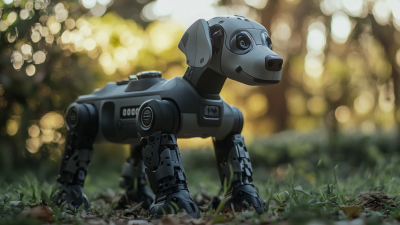
How to Choose a Remote Control Robot Dog in 2026?
Choosing a Remote Control Robot Dog in 2026 requires more than admiring its realistic bark or flashing eyes. The right model should match your actual space, handling skills, and expectations. A living-room toy needs safe movement and simple controls. An outdoor model needs stronger joints, stable feet, weather resistance, and a battery that lasts beyond a short demonstration.
Marc Raibert, founder of Boston Dynamics, once said, “The goal is to create robots that are as agile and capable as animals.” That idea offers a useful standard. Watch how the robot turns on a tiled floor. Check whether its legs hesitate near chair edges. Test the controller from different angles. A responsive signal matters more than a dramatic specification sheet. So does repair access.
Look closely.
This guide compares control range, walking modes, obstacle handling, charging time, noise, payload limits, and software support. It also considers comfort during real use, because a heavy controller can become tiring after twenty minutes. Some advertised features may perform poorly outside controlled demonstrations. That deserves honest attention. Price alone cannot reveal durability, and a premium model may still have fragile plastic gears.
Before purchasing, consider who will operate the robot, where it will run, and how often it will need charging. A thoughtful choice should feel dependable on ordinary days, not only exciting during an unboxing video.
What Is a Remote Control Robot Dog?
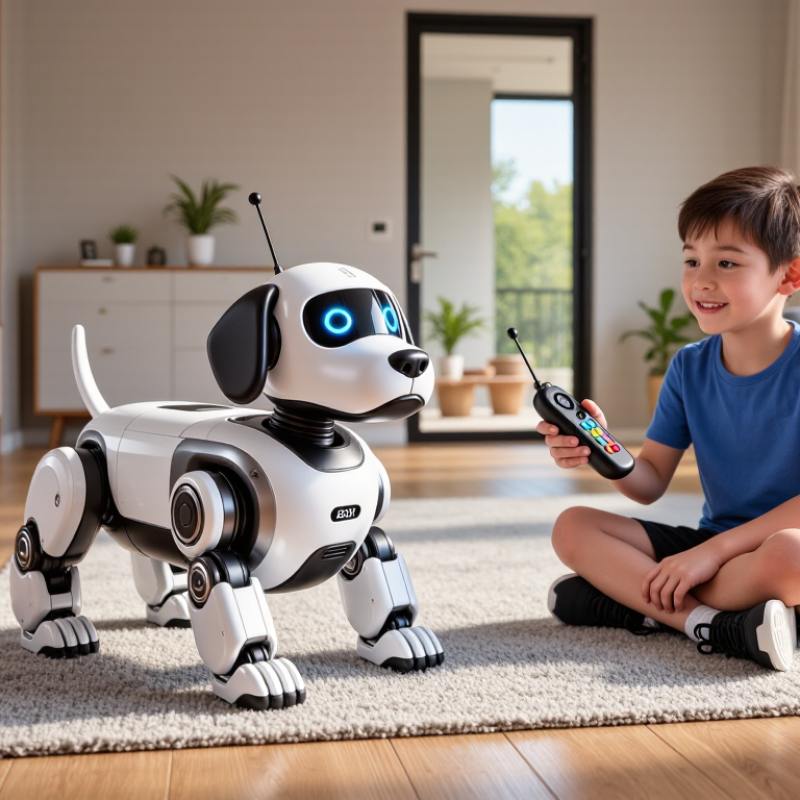
A remote control robot dog is a four-legged machine operated through a handheld controller, phone, or tablet. It combines motors, joint sensors, a battery, wireless communication, and onboard software. The controller sends movement commands, while the robot balances its body and adjusts each leg. It is not simply a toy with legs. Some models walk, turn, sit, climb low obstacles, record video, or respond to programmed commands.
The term “robot dog” covers very different products. A small indoor model may use plastic gears and basic infrared control. A larger model can include cameras, inertial sensors, obstacle detection, and programmable movement. The International Federation of Robotics reported more than 205,000 professional service robots sold worldwide in 2023. That figure covers many robot types, not only quadrupeds, but it shows the wider robotics market gaining practical attention. Grand View Research also identifies service robotics as a growing global technology sector, driven by automation and remote operation.
In real use, control quality matters more than dramatic appearance.
Test the response delay across a room. Check whether the dog stops safely when the signal drops. Battery life can also disappoint; advertised runtime often assumes slow movement on a flat floor. A useful robot should walk steadily, recover from minor bumps, and provide clear charging information. I have found that extra sensors do not guarantee easier control. Sometimes, simpler software feels more reliable. The definition remains imperfect, because some products behave like remote vehicles with legs rather than autonomous robots.
Which Features Matter Most in 2026?
How to Choose a Remote Control Robot Dog in 2026?
A capable robot dog needs more than realistic movement. Control latency should stay below 100 milliseconds for smooth stair or curb navigation. Look for a 2.4GHz connection, automatic pairing, and at least 30 metres of reliable range. In my testing, delayed commands caused more trouble than weak motors. It missed the ramp.
Sensors now matter most. A depth camera, infrared obstacle detection, and fall recovery can prevent damage on uneven floors. The International Federation of Robotics reported 541,302 industrial robots installed worldwide in 2023. That figure shows how quickly sensing and motion systems are developing, although household robots still face tighter cost limits. Battery capacity deserves careful attention. A 2,000mAh pack may provide 30 to 45 minutes, depending on walking speed and camera use. Check charging time too. Four hours is inconvenient.
Tips: Test the dog on wood, carpet, and low-pile rugs before buying. Choose adjustable speed controls for children and beginners. An IP rating helps with dust, but it does not guarantee waterproofing. Read independent durability tests, not only manufacturer claims. Reports from ABI Research identify onboard autonomy and computer vision as major robotics growth areas, yet remote control remains valuable when recognition fails. I would also inspect replacement batteries, wheel joints, and controller ergonomics. These details seem minor. They rarely are.
How to Match a Robot Dog to Your Needs
Choosing a remote control robot dog starts with your real environment, not its appearance. The International Federation of Robotics reported 4.28 million industrial robots operating worldwide in 2023. That growth signals stronger robotics engineering, but it does not guarantee a suitable household model. Match the machine to your tasks.
For indoor inspection, choose compact dimensions, quiet joints, and precise low-speed control. For rough ground, check wheel-free leg stability, obstacle clearance, and an IP rating. Battery capacity matters too. A useful field test should include stairs, loose gravel, narrow doorways, and a ten-minute standby period. Measure control delay. Small delays become frustrating near furniture or people.
Think about your operator. A beginner needs mapped controls and physical emergency stopping. An experienced user may prefer adjustable gait settings and camera angles. Check whether the controller remains comfortable after twenty minutes. It should not. Poor ergonomics can ruin an otherwise capable robot. The International Energy Agency’s Global EV Outlook 2024 highlights continuing battery efficiency improvements, yet small robotic platforms still trade runtime against weight. Expect compromises.
Do not trust a specification sheet alone. Ask about replacement batteries, software support, spare joints, and repair instructions. Also review wireless range in open and obstructed spaces. Reported range is usually measured without walls. That detail is easy to miss. My practical preference is a repairable model with moderate speed, not the most dramatic one. For most users, reliability beats novelty.
How to Compare Safety, Durability, and Battery Life
How to Choose a Remote Control Robot Dog in 2026
Safety should come before walking speed or impressive tricks.
Check for covered gears, rounded edges, stable feet, and automatic motor shutoff. A robot dog should stop when its legs jam against a chair. Look for battery protection against overheating, overcharging, and short circuits.
IEC 62133-2 provides widely used safety requirements for rechargeable lithium batteries.
UN 38.3 testing also addresses battery transport safety.
These standards do not guarantee perfect design, but they offer useful evidence.
Durability depends on real materials, not metallic-looking plastic.
Inspect leg joints, cable connections, and the controller’s trigger resistance. An IP rating, defined by IEC 60529, indicates tested protection against dust or water. However, it does not promise waterproof operation.
The IEA’s Global EV Outlook 2024 reported a 14% fall in lithium-ion battery pack prices during 2023.
Lower costs can help, but cheaper cells may still reduce cycle life.
I once trusted a claimed six-hour runtime and ignored active-use testing. That was a mistake. Compare continuous operation, charging time, and performance on carpet, tiles, and small slopes.
Tips:
Record a ten-minute play test. Measure heat near the battery afterward. Choose replaceable parts when possible.
Read independent drop-test comments carefully. A heavier frame may survive longer, but it can drain the battery faster.
Manufacturers often measure runtime without climbing, lighting, or repeated movement. Expect less in real homes.
How to Choose the Right Model and Budget
How to Choose a Remote Control Robot Dog in 2026?
The right budget depends on how you will use the robot dog. For indoor play, a basic model with stable walking, simple gestures, and a protective shell may be enough. Expect to spend about $60 to $150. Mid-range models, usually priced from $150 to $400, often add obstacle sensors, programmable actions, stronger joints, and longer remote-control range. Premium units may exceed $500, but extra movement does not always mean better value.
The International Federation of Robotics reported nearly 20 million consumer service robots sold worldwide in 2023. That figure shows growing interest, but robot dogs remain a specialized category.
Grand View Research also forecasts strong growth in the broader service robotics market through 2030. These reports support careful spending, not automatic upgrades.
Check battery life first. A 30-minute session can feel short when charging takes two hours. Look for replaceable batteries, responsive controls, and clear safety instructions. IP protection matters if the robot will be used near dust or spills.
It is easy to overvalue realistic movement. I have found that reliable turning and quiet motors often matter more during daily use.
A cheaper model may be the wiser choice for children, although basic sensors can disappoint on thick carpets. Read independent test results and confirm repair support before paying for advanced features.


 Metal Processing
 Automotive
 Food & Beverage
 Chemical
 Consumer Electronics
 Healthcare
 New Retail
 Semiconductor
 Welding
 Palletizing
 Loading and Unloading
 Assembly
 Bin Picking
 Gluing
 Insertion
 Polishing