Providing professional services to meet various customer needs and qualified technical support to answer multiple questions.
You ask - we answer.
Top 10 Coil Spring Manufacturers for Global Buyers?
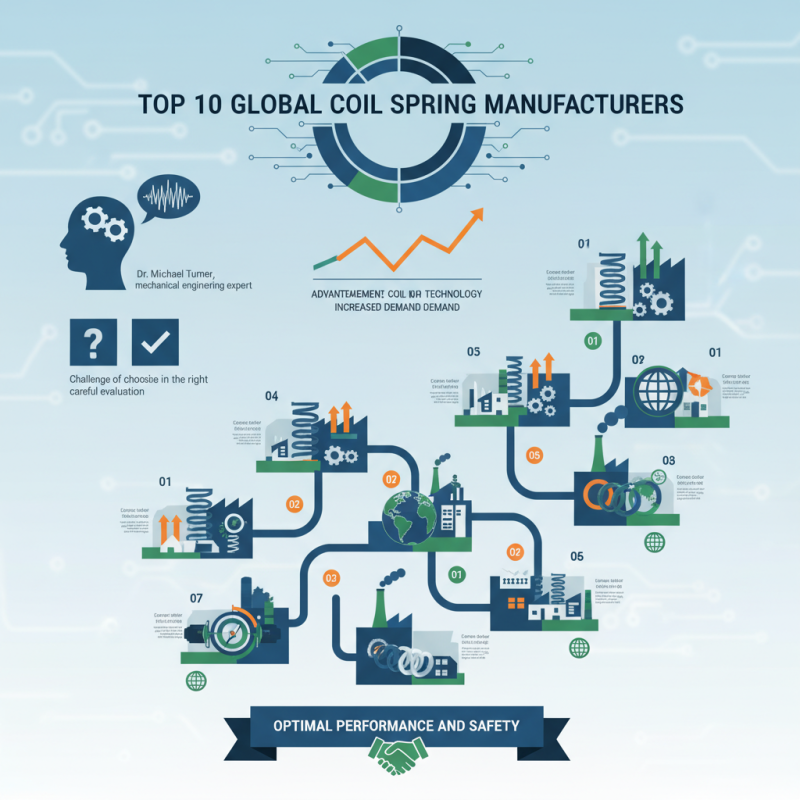
In the competitive landscape of the manufacturing industry, the importance of high-quality Coil Springs cannot be overstated. Renowned expert Dr. Michael Turner, an authority in mechanical engineering, once stated, "Coil springs are fundamental components that influence a vehicle's performance and safety." With advancements in technology, the demand for reliable coil spring manufacturers has surged globally.
For buyers, choosing the right manufacturer can be challenging. Market players vary in expertise and product quality. Some companies offer innovative solutions, while others might struggle with consistency. This diversity highlights the need for careful evaluation.
In this article, we explore the top 10 coil spring manufacturers catering to global buyers. Each company plays a crucial role in providing essential products that meet precise industry standards. Understanding these manufacturers can help businesses make informed decisions, ensuring optimal performance and safety in applications that depend on coil springs.
Overview of Coil Spring Applications in Various Industries
Coil springs play a vital role in various industries, offering flexibility and support in numerous applications. In the automotive sector, they help absorb shocks and stabilize the vehicle's body. This ensures a smooth ride, even on rough terrain. Manufacturers use advanced materials to enhance durability and performance, though some find it challenging to strike a balance between weight and strength.
In the industrial field, coil springs are essential in machinery and equipment. They support moving parts, maintain tension, and assist in load bearing. While these springs are reliable, the spectrum of quality can vary. Selecting the right spring often involves evaluating specific requirements like load capacity and environmental conditions. It's crucial to ensure that the chosen spring meets industry standards.
Coil springs also find use in consumer products. Applications range from furniture to electronics, adding comfort and functionality. Despite their prevalence, the design process can be complex. Engineers must consider factors such as fatigue life and stress distribution. Failure to address these could lead to premature wear or functional issues. This highlights the need for thorough testing and validation.
Criteria for Selecting Top Coil Spring Manufacturers
When selecting coil spring manufacturers, buyers should focus on several critical criteria. One important factor is material quality. Springs must be made from durable materials to ensure longevity and performance. Buyers should seek manufacturers that use high-grade steel or specialized alloys. This significantly impacts the spring's resilience and fatigue life.
Another key aspect is manufacturing processes. Advanced techniques, such as heat treatment and precision machining, contribute to better product reliability. A manufacturer's attention to detail in these processes can indicate their commitment to quality. It’s also helpful to evaluate their certifications. Compliance with industry standards reflects a manufacturer's expertise and credibility.
Customer service plays a vital role as well. A responsive and knowledgeable support team can address concerns effectively. This builds trust and fosters a strong partnership. Ultimately, exploring customer reviews can provide insights into the manufacturer's reputation. Engaging with feedback from previous clients adds depth to the selection process. Reliable manufacturers should prioritize transparency and communication throughout the buying journey.
Top 10 Coil Spring Manufacturers for Global Buyers
Manufacturer Location
Annual Revenue (Million USD)
Production Capacity (Units per Year)
Key Industries Served
Certifications
USA
120
1,000,000
Automotive, Aerospace
ISO 9001, TS 16949
Germany
150
800,000
Industrial Machinery, Automotive
ISO 9001, IATF 16949
Japan
200
1,200,000
Automotive, Electronics
ISO 9001, ISO/TS 16949
China
100
1,500,000
Construction, Automotive
ISO 9001
South Korea
80
600,000
Automotive, Aerospace
ISO 9001
India
90
700,000
Automotive, Railways
ISO 9001
Italy
110
500,000
Automotive, Furniture
ISO 9001
France
130
900,000
Automotive, Aerospace
ISO 9001, AS 9100
Brazil
70
400,000
Automotive, Heavy Machinery
ISO 9001
UK
95
650,000
Automotive, Aerospace
ISO 9001, AS 9100
Detailed Profiles of Leading Coil Spring Manufacturers
Coil springs play a crucial role in many industries. When choosing a manufacturer, understanding their profiles is essential. Each has unique strengths that appeal to diverse needs. Buyers must consider various factors.
One important aspect is the manufacturing process. Advanced techniques ensure durability and reliability. This can significantly affect performance. Moreover, not all manufacturers invest equally in technology. Buyers should look for those who prioritize innovation.
Tips: Always request product samples. This helps assess quality firsthand. Consider visiting manufacturing facilities if possible. Personal observation can reveal a lot about production standards. Engaging with industry experts for guidance can also improve decision-making.
While many manufacturers offer solid products, evaluating after-sales support is vital. Good support can make a difference in long-term satisfaction. Assessing customer feedback provides insights into real-world performance. The experiences of other buyers shed light on potential issues.
Tips: Check reviews on independent platforms. This adds to the reliability of gathered information. Don't shy away from asking tough questions during your evaluation. Effective communication helps clarify expectations and builds trust.
Comparison of Manufacturing Processes and Technologies
In the world of coil spring manufacturing, processes vary widely. Manufacturers typically use either cold or hot coiling techniques. Cold coiling often results in tighter tolerances and finer finishes. It’s a process that generally involves less energy and provides better accuracy. However, it might limit the thickness of the wire that can be used.
Hot coiling, on the other hand, allows for more robust springs. This method can accommodate thicker materials. Yet, it demands more energy and precise temperature control. Tempering follows both processes to enhance the springs' mechanical properties. This step is crucial for ensuring durability.
Investors should also consider technological advancements like automated machinery. Automation can yield consistency, but may introduce new challenges in quality control. As groundbreaking as these innovations are, they occasionally result in unexpected defects due to programming errors. Manufacturers need to weigh the benefits of technology against potential downsides. They must address the learning curve and maintenance issues that come with automation.
Comparison of Manufacturing Processes and Technologies Used by Top Coil Spring Manufacturers
This bar chart illustrates the efficiency and production capacity measured in percentage output of various manufacturing processes utilized by leading coil spring manufacturers globally. The data reflects the adoption of advanced technologies and techniques in the coil spring manufacturing industry.
Market Trends and Future Outlook for Coil Spring Production
The coil spring industry is experiencing significant changes. Market research indicates a projected growth rate of 5.2% CAGR from 2021 to 2026. This growth is fueled by increasing demand in various sectors, such as automotive, aerospace, and industrial machinery. As these industries expand, so does the need for high-quality coil springs.
Sustainability is becoming a key trend. Manufacturers are adopting eco-friendly materials and processes. Reports suggest that around 30% of companies are now prioritizing sustainable practices. This transition not only helps the environment but also appeals to consumers who value ethical production. Nevertheless, challenges remain. Some companies struggle to integrate these practices while maintaining profitability.
The future outlook is promising, yet unpredictable. Material costs fluctuate and supply chain disruptions persist. Recent data shows that raw material prices have increased by nearly 15% in the past year. Companies must adapt to these changes or risk falling behind. The focus will be on innovation and efficiency. Embracing new technologies could give a competitive edge. However, this often requires upfront investment. Balancing these factors is crucial for long-term success.
Learn useful insights, save and exchange knowledge easily with MyDobot User Center
Establish Contact with Dobot Experts
Take part in automation transformation. Let’s work together towards a more efficient tomorrow.
Contact Information
Virtual Controller Application
We provide a free trial application for the robot cloud virtual controller. Fill in the following information and we will issue you a 12-hour license.
Contact Information
File sent
The related product information has been sent, please kindly check your email.
Loading, please wait...
Join Dobot+ Ecosystem to Forge Deeper Partnerships
Dobot sincerely invites robotics software companies and hardware manufacturers to Dobot+. Together we can offer best in class solutions to end users in various industries.