What is a Position Sensor and How Does it Work?
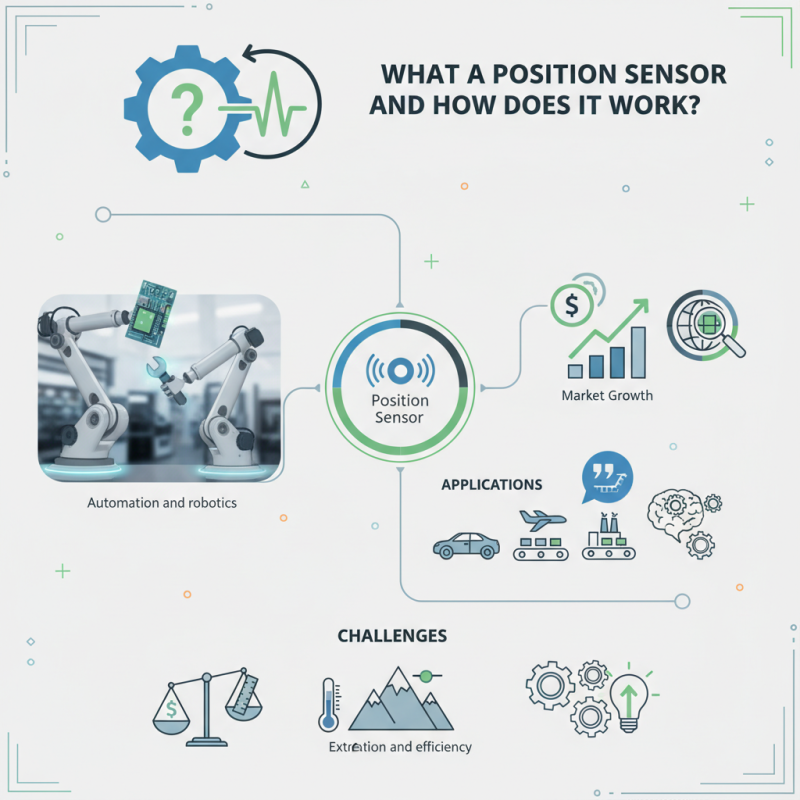
In the ever-evolving world of automation and robotics, the importance of Position Sensors cannot be overstated. A position sensor detects the position or movement of an object with precision. According to a report by MarketsandMarkets, the global position sensor market is expected to reach $3.6 billion by 2025. This growth highlights the rising demand for accurate and reliable sensing technologies.
Dr. Emily Carter, a leading expert in sensor technology, once remarked, “Position sensors are the backbone of modern automation.” This statement captures the essence of position sensors in various industries, from automotive to aerospace. They provide critical data for systems requiring high accuracy in determining the location of mechanical components.
Despite advancements, challenges remain. Developing sensors that are both cost-effective and highly precise is a continual struggle. Furthermore, environments with extreme conditions may affect sensor performance. As the industry grows, addressing these imperfections will be crucial for innovation and efficiency in position sensing technologies.
What is a Position Sensor?
Position sensors play a crucial role in various industries. They provide feedback on the location of an object within a defined space. These sensors are integral in applications like robotics, automotive systems, and industrial automation. According to industry data, the position sensor market is projected to reach $5.4 billion by 2025, reflecting a compound annual growth rate of 7.5%. This growth is driven by advancements in sensor technology and increasing automation demands.
Understanding position sensors requires knowledge of their types and functionalities. Common types include potentiometric, capacitive, and magnetic sensors. Each type has its unique strengths and limitations. For instance, potentiometric sensors are simple and inexpensive but may lack durability. Capacitive sensors offer high accuracy but can be sensitive to environmental changes. Innovating in this field remains a challenge. Engineers often face trade-offs between accuracy, cost, and reliability.
In many applications, sensors must be both robust and precise. Challenges in achieving these specifications can lead to operational inefficiencies. For instance, the wrong choice of a sensor can cause delays in automated processes. Furthermore, integrating sensors into existing systems can be complex and time-consuming. The industry must continue to explore better solutions to enhance the effectiveness of position sensors in real-world applications.
Types of Position Sensors and Their Applications
Position sensors play a crucial role in various applications. They help to detect and measure the position of objects. There are different types of position sensors, each with unique features. Common types include potentiometers, encoders, and magnetostrictive sensors. These sensors have distinct working principles and different use cases.
Potentiometers are simple devices. They change resistance based on shaft movement. These sensors are often used in joystick controls. They can be less accurate over time. Encoders, on the other hand, provide precise digital feedback. They convert position information into digital signals. These devices are frequently found in robotics and CNC machines. They can be quite complex and require careful calibration.
Magnetostrictive sensors offer non-contact measurement. They use magnetic fields to determine position. These sensors are reliable in harsh environments. Their durability is a strong advantage. However, they can be more expensive. Engineers must consider costs before choosing a sensor type. Each sensor has strengths and weaknesses. The selection often involves trade-offs to meet specific needs.
How Position Sensors Work: Principles and Mechanisms
Position sensors are vital components in various industries. They determine the location of an object in relation to a reference point. These sensors utilize several principles and mechanisms to achieve accurate positioning.
One common mechanism is the resistive position sensor. This type changes resistance based on its position. According to a recent industry report, the global position sensor market was valued at approximately $3.6 billion in 2022, with expectations to grow at a CAGR of over 6% through 2030. Electromagnetic and capacitive sensors are also popular. They work by measuring changes in capacitance or magnetic fields to infer position. Each mechanism has its strengths and weaknesses.
While these technologies are precise, they can be affected by environmental factors. Temperature changes may affect sensor accuracy. The installation process and mechanical stress can also introduce errors. Continuous improvement efforts are essential in addressing these challenges. Understanding the nuances of position sensors is crucial for effective application in automation, robotics, and many other fields.
Common Uses of Position Sensors in Industry
Position sensors play a crucial role in various industries. They measure the position of an object within a specific range. Their applications are wide-ranging and vital for automation processes. For instance, a report from the International Society of Automation noted that the global position sensor market is set to grow by over 10% annually.
In manufacturing, position sensors assist in robotics and assembly lines. They ensure that machines operate precisely. According to a recent survey by MarketsandMarkets, about 35% of industries utilize position sensors for quality control. This enhances productivity while minimizing errors. Another common use is in automotive applications. Modern vehicles rely on these sensors for features like parking assistance and stability control. This creates a safer driving experience, but over-reliance on technology can also lead to oversight.
However, the effectiveness of position sensors depends on accurate calibration. Even minor errors can lead to significant operational issues. Real-world applications sometimes reveal a disconnect between sensor capabilities and actual need. This highlights the importance of regular maintenance and recalibration. As industries evolve, understanding these nuances becomes essential for optimizing sensor performance.
What is a Position Sensor and How Does it Work? - Common Uses of Position Sensors in Industry
| Sensor Type | Working Principle | Common Applications | Advantages |
| Potentiometric | Measures resistance change with position | Robotic arms, joystick controls | Simple design, low cost |
| Hall Effect | Detects magnetic fields | Automotive position sensing, motors | Non-contact, reliable |
| Inductive | Measures changes in inductance | Industrial automation, conveyor systems | Durable, suitable for harsh environments |
| Optical | Uses light interruption or reflection | Positioning in CNC machines, automation | High precision, fast response |
| Capacitive | Measures changes in capacitance | Touch sensors, level sensing | Highly sensitive, non-contact |
Advantages and Limitations of Position Sensors
Position sensors are vital components in many applications. They convert the physical position of an object into an electrical signal. This signal helps in monitoring and controlling movement. There are various types of position sensors, each with unique benefits and challenges.
One advantage of position sensors is accuracy. They provide precise measurements in real-time. This is crucial in robotics and automation. Additionally, they are often compact, making them easy to integrate into different systems. However, some sensors may have limited range. Others might be sensitive to environmental factors like temperature and humidity. These limitations require careful selection based on the application's needs.
Maintenance can also be a concern. Some position sensors may require regular calibration. This ensures consistent performance over time. Moreover, they can be costly to replace or fix. In harsh environments, wear and tear may accelerate. Thus, users must weigh these factors when choosing the right position sensor for their projects.


 Metal Processing
 Automotive
 Food & Beverage
 Chemical
 Consumer Electronics
 Healthcare
 New Retail
 Semiconductor
 Welding
 Palletizing
 Loading and Unloading
 Assembly
 Bin Picking
 Gluing
 Insertion
 Polishing
