Providing professional services to meet various customer needs and qualified technical support to answer multiple questions.
You ask - we answer.
What is an Alloy Powder Grader and How Does it Work?
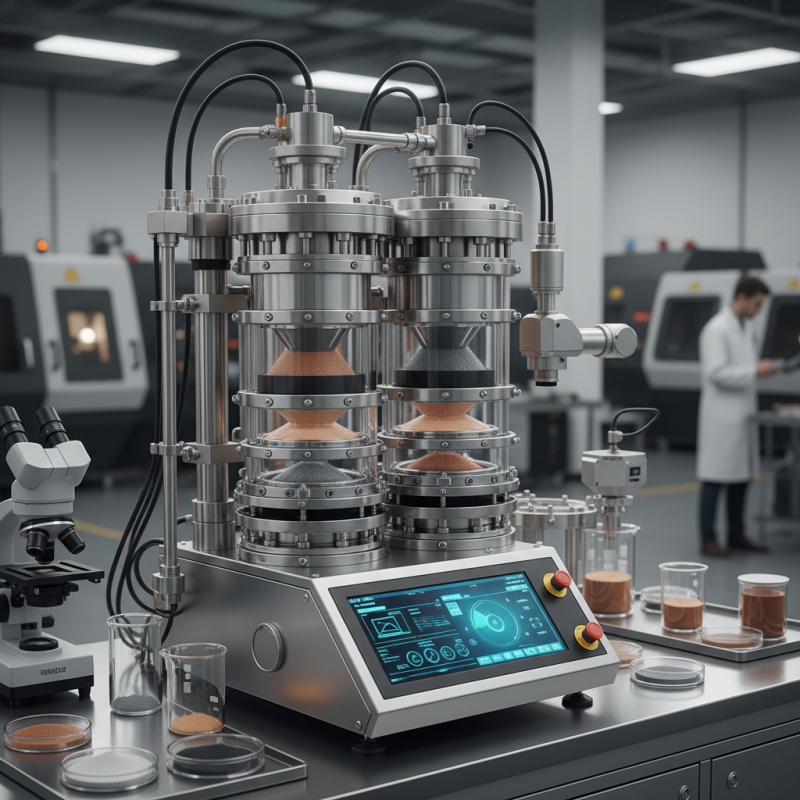
An Alloy Powder Grader is essential in the manufacturing industry. It measures and classifies metal powders based on specific characteristics. This device ensures that powder quality meets rigorous standards.
Accurate grading is crucial for diverse applications. Poorly graded powders can lead to defects in finished products. These defects may cause performance issues and increased costs. The Alloy Powder Grader works by analyzing the particle size and distribution. It utilizes advanced technologies to deliver precise measurements.
While these graders are effective, they are not without flaws. Calibration errors can occur, impacting results. Users must regularly maintain and calibrate the device. Understanding its limitations is key to maximizing performance. The Alloy Powder Grader plays a vital role, yet it requires thoughtful operation to achieve optimal results.
An alloy powder grader is a vital tool in manufacturing sectors, specifically in metal powder production. It plays a crucial role in determining particle size distribution. This affects the performance of various metal components. Accurate grading ensures consistent quality in applications like 3D printing and metal injection molding. According to industry reports, over 70% of metal powder used in additive manufacturing relies on precise grading to achieve optimal results.
Tips: Regular calibration of the alloy powder grader can enhance its performance. Consistency in measurements is key for high-quality output.
The operation of an alloy powder grader is quite fascinating. It employs various techniques such as sieving, laser diffraction, or dynamic image analysis to classify powder sizes. Each method has its strengths and weaknesses. A study noted that laser diffraction can miss finer particles sometimes. This emphasizes the need for continuous review and potential adjustments in grading processes.
Tips: Combining different methods can provide a more comprehensive view of particle sizes. Be open to experimenting with new techniques for better results.
What is an Alloy Powder Grader and How Does it Work?
Feature
Description
Purpose
To classify and grade metal powders based on particle size distribution.
Key Components
Vibrating screens, sieves, and particle size analyzers.
Working Principle
Uses mechanical vibration to separate particles based on size.
Typical Applications
Manufacturing of metal parts, additive manufacturing, and powder metallurgy.
Material Types
Aluminum, titanium, stainless steel, and various metal alloys.
Benefits
Improves product quality, enhances performance, and optimizes manufacturing processes.
Future Trends
Integration of AI for improved accuracy and efficiency in grading processes.
The Importance of Alloy Powder Grading in Manufacturing
Alloy powder grading plays a crucial role in manufacturing. It ensures that the materials used meet specific properties. These properties influence the final product's strength and durability. Accurate grading determines the size and distribution of powder particles. This impacts how well they blend and react during processing.
Manufacturers need to focus on consistency. Inconsistent alloy powders can lead to production errors. Such errors might compromise product quality. Therefore, proper grading is not just useful; it is essential. It helps avoid costly rework and minimizes waste in production.
Quality checks during grading are vital. Visual inspections and particle size analysis are common methods. However, these checks may not always catch every issue. Sometimes, extensive testing is overlooked due to time constraints. This can lead to significant problems later. A small mistake in grading can lead to a defective batch. That’s an area where manufacturers need to reflect and improve.
Alloy Powder Grading in Manufacturing
This chart illustrates the particle size distribution of various alloy powders commonly used in manufacturing. The particle size is crucial for determining the properties of the final products made from these alloys.
How Alloy Powder Graders Function Mechanically
Alloy powder graders are essential tools in various industries. They play a crucial role in metal processing. The mechanical function of these graders is fascinating and complex.
At their core, alloy powder graders operate through a series of sieves. These sieves are designed to separate powder particles based on size. As the powder passes through, smaller particles fall through the openings. This separates materials effectively. The flow of powder is often controlled by vibrational movements. These vibrations can be adjusted to achieve different grading speeds.
However, the process isn't flawless. Sometimes, fine particles can clump together. This can lead to inaccurate grading results. Regular maintenance is necessary to ensure optimal performance. Operators must be vigilant. Often, they overlook the importance of checking for wear and tear on the sieves. When they do, it can affect the final output quality. Understanding these mechanical intricacies is vital for any user of alloy powder graders.
Different Types of Alloy Powder Graders and Their Applications
Alloy powder graders play a vital role in various industries. These machines help in classifying alloy powders based on size and density. Different types serve distinct needs. For example, gas atomized powder requires different grading than mechanically alloyed powder.
One common type of alloy powder grader is the air classifier. It uses air flow to separate particles. This method is efficient for lighter powders. Another type is the vibratory sieve, which relies on vibration. It works well for achieving precise separation in a short time. Each type has specific applications, like aerospace or medical. They require careful calibration and material handling.
Tip: When choosing a grader, consider your material's characteristics. Not all powders respond the same to grading technologies. Testing different machines can yield better results.
Another important factor is maintenance. Graders can accumulate dust and residual material. Regular cleaning is essential for consistent performance. Neglecting this can lead to inaccurate separation.
Tip: Schedule routine maintenance checks to ensure optimal operation. Discuss your production needs with experts to find the best fit for your operation. Understanding the nuances of your powders can significantly affect efficiency and quality.
Benefits of Using Alloy Powder Graders in Industry
Alloy powder graders have become essential tools in various industries, particularly in metal manufacturing. These graders ensure that powder materials meet specific particle size requirements, which is critical for the production of high-quality components. According to a recent industry report, over 70% of manufacturers face issues with inconsistent powder sizes, leading to increased defects and production downtime.
Utilizing alloy powder graders can significantly reduce these problems. With precise grading, manufacturers can achieve uniformity in their materials. This consistency not only improves product quality but also enhances overall efficiency. Studies show that companies using high-performance grading technology can improve yield rates by up to 15%. This improvement is crucial in competitive markets, where every fraction of a percentage in yield can lead to substantial cost savings.
However, there are challenges. Many operations struggle with integrating advanced grading equipment into existing processes. Training staff to operate new technology can be daunting. Despite these hurdles, the benefits of using alloy powder graders are clear. The potential for improved accuracy and quality often outweighs the initial difficulties. As industries continue to evolve, overcoming these challenges will be vital for manufacturers aiming to stay competitive.
Learn useful insights, save and exchange knowledge easily with MyDobot User Center
Establish Contact with Dobot Experts
Take part in automation transformation. Let’s work together towards a more efficient tomorrow.
Contact Information
Virtual Controller Application
We provide a free trial application for the robot cloud virtual controller. Fill in the following information and we will issue you a 12-hour license.
Contact Information
File sent
The related product information has been sent, please kindly check your email.
Loading, please wait...
Join Dobot+ Ecosystem to Forge Deeper Partnerships
Dobot sincerely invites robotics software companies and hardware manufacturers to Dobot+. Together we can offer best in class solutions to end users in various industries.